Castles of Sicily
History, Legends and Flavours
Ten fortresses, centuries of history and a few ghosts. An itinerary written by someone who lives here.
The Route
Let me tell you something: Sicily has more than two hundred castles. Two hundred. Most people don’t know this, or barely know them by name. Yet every castle on this island is a piece of lived history – wars, betrayals, impossible loves, ghosts, and extraordinary food. Because yes, even the gastronomy changes from castle to castle, from province to province.
I built this itinerary trying to avoid stages that are too long and exhausting routes. We travel from east to west, following the thread of history: from the Normans to the Swabians, from the Aragonese to the Bourbons. You don’t need to be a historian – all you need is curiosity and good company.

Catania is black with lava stone and full of beautiful contradictions. Castello Ursino – commissioned by Frederick II of Swabia in the 13th century – is its perfect symbol: sober, imposing, built to last. Consider that it originally stood by the sea, then Etna decided otherwise and today it sits wedged between the buildings of the city centre.
Inside is the Civic Museum, with a collection of medieval and modern art that surprises every time. Allow at least a couple of hours, without rushing.
- The four cylindrical corner towers
- The Frederician inner courtyard
- Civic Museum with medieval and modern collection
- The moat ditch, still visible
- Pasta alla Norma – aubergine, tomato and salted ricotta. No better version exists than in Catania
- Arancino col burro – in Catania it’s masculine, it’s large and they add butter
- Mulberry or almond granita in the morning, with a brioche col tuppo

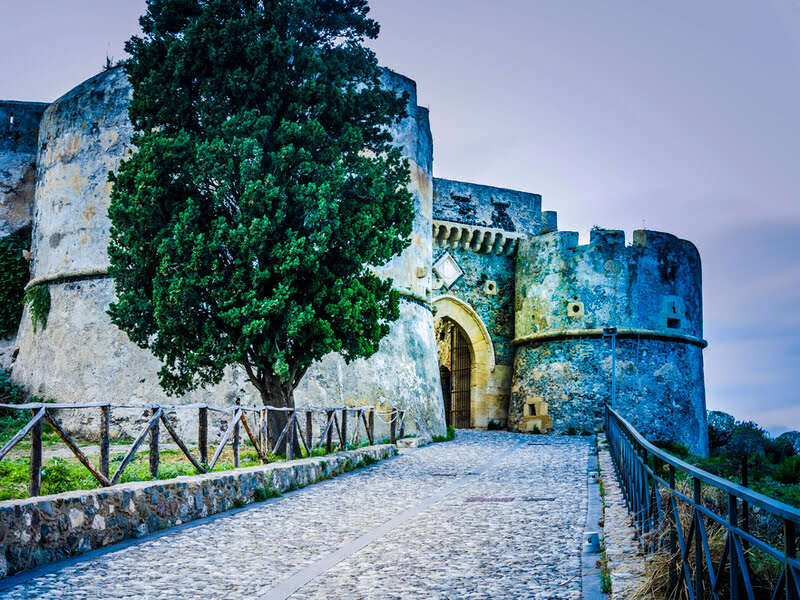
Castello Maniace is one of those places that takes your breath away the moment you see it, positioned as it is at the very tip of Ortigia, with the sea wrapping around three of its sides. This too is by Frederick II, this too is from the 13th century – but its position makes it unique across the entire island.
The name comes from George Maniakes, the Byzantine general who in the 11th century wrested Syracuse from the Arabs. The Gothic-Swabian marble portal at the entrance is one of the most beautiful things you will see on this journey.
- The decorated Gothic-Swabian marble portal
- The view over the Grand Harbour at sunset
- The armoury and perimeter walls
- The Ortigia market just steps away
- Pane cunzato at the Ortigia market – anchovies, caciocavallo, fresh tomato
- Pasta with sardines and wild fennel
- Seasonal seafood – crab and sea urchins when available

Donnafugata is not a medieval castle in the strict sense – it is a Neo-Gothic villa from the 19th century, the property of the Arezzo de Spuches barons. But it has everything one asks of a castle: 122 rooms, a park with mazes and artificial grottoes, an atmosphere suspended between the romantic and the unsettling.
If the name sounds familiar, it’s because several scenes of Inspector Montalbano were filmed here. Coming after watching the series is a strange and beautiful experience.
- The maze in the park – you genuinely get lost
- The noble halls with period furnishings
- The Neo-Gothic façade in the early morning
- The artificial grottoes in the gardens
- Scacce ragusane – pasta sheets filled with tomato and cheese
- Caciocavallo ragusano DOP – the cheese of the Iblean Mountains, incredible
- Modica chocolate – raw, no butter, ancient. Just 15 minutes away
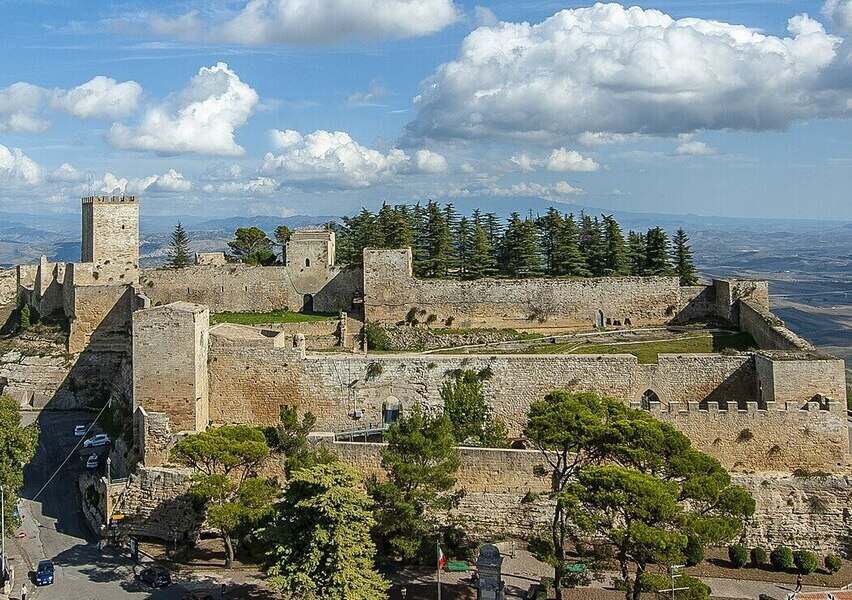
Enna is the highest provincial capital in Italy – nearly 1,000 metres – and the Castello di Lombardia has watched over it from above since before the year 1000. Its origins are Siculian, the current structure Norman and expanded by Frederick II. Of the original twenty towers, six remain, including the Torre Pisana, from which on a clear day you can see the whole of Sicily.
Bring a jumper even in summer – there is always wind up there, and the view from the Torre Pisana is worth any thermal discomfort.
- Torre Pisana – the panoramic view is unmatched
- The courtyard and the six surviving towers
- The open-air theatre set within the courtyard
- The Rocca di Cerere just steps away
- Maccheroni with pork ragù – Ennese cuisine is robust, mountain people’s food
- Stigghiola of lamb on the grill – don’t ask what it is, just eat it
- Valguarnera wine – the inland vineyards produce a powerful and honest red

This is my favourite. The Castello di Mussomeli – also known as Manfredonico after the Chiaramonte family who commissioned it – rises on an isolated rocky crag at 778 metres altitude. Seen from the motorway it looks suspended in mid-air. Up close it is even more impressive: the walls follow the rock, as though they grew out of it.
It is not an easy castle to reach – the final stretch of road is narrow and at times awkward – but nobody who has been there has ever regretted it.
- The crag and the surrounding landscape – photograph it from afar before climbing up
- The interior rooms and the chapel
- The courtyard with access to the cistern
- The view over the Platani Valley
- Falsomagro – a roll of minced meat stuffed with hard-boiled eggs and cheese, a festive dish
- Broad bean and chicory soup – humble and extraordinary cooking
- Freshly made sheep’s ricotta – the shepherds here still sell it by the roadside
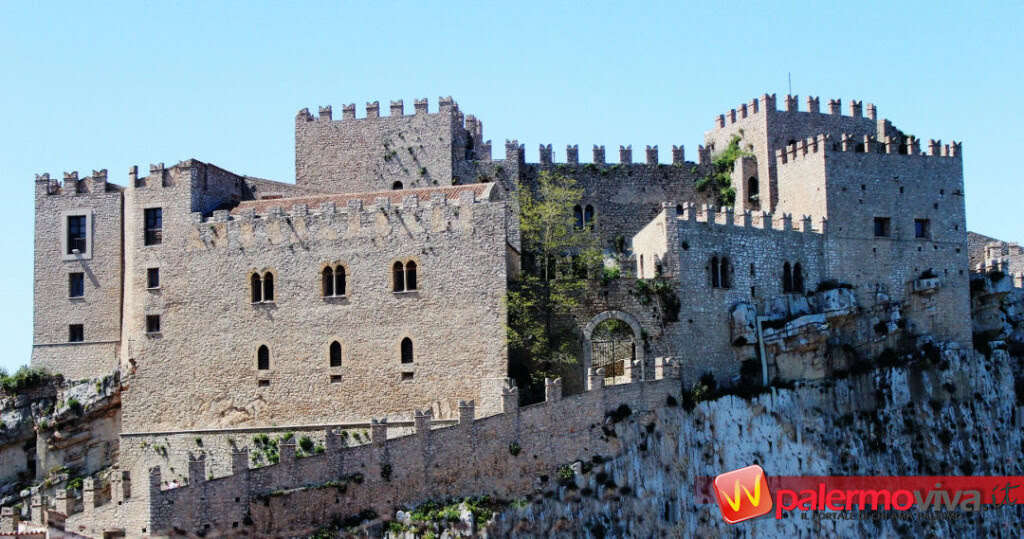
The Castello di Caccamo is among the best preserved in all of Sicily. Built by the Normans in the 12th century and later expanded by the Chiaramonte and De Spuches families, it dominates the valley of the San Leonardo river from a position that looks chosen by a painter. The village below is one of those places where time seems to slow down.
Inside there is everything: frescoed halls, an underground prison that sends shivers down the spine, furnished noble apartments. It is a living museum of Sicilian medieval life.
- The Hall of the Conspiracy – where the plot against William I was hatched
- The underground prison
- The frescoes in the noble halls
- The panorama from the terrace over the San Leonardo river
- Sfincione palermitano – thick, soft, tomato and breadcrumbs. It is not pizza
- Pane ca meusa – spleen fried in lard. Try it even if it frightens you
- Cannolo filled to order – never one made the day before
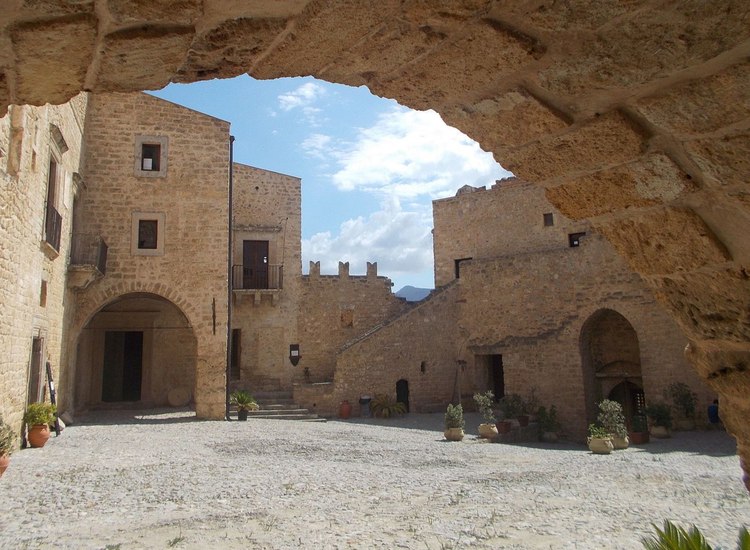
The Castello La Grua Talamanca of Carini is famous for a tragic story that every Sicilian knows: the murder of the Baroness Laura Lanza, killed for reasons of honour in 1563. She was a young woman in love with her cousin, and her husband did not forgive her. The story became an anonymous poem, one of the most beautiful texts in Sicilian literature.
On moonlit nights, they say, her lament can still be heard between the walls. I have never been there at night, but after reading the Baroness poem, the stones of the castle carry a different weight.
- The Baroness’s room – according to tradition, the scene of the crime
- The Renaissance decorations from the sixteenth century
- The panorama over the village of Carini
- The cultural events linked to the story of Laura Lanza
- Frittola palermitana – meat scraps fried in lard, ancient street food
- Pasta con le broccole arriminata – cabbage tossed with anchovies and raisins
- Artisan cassata siciliana – the real one, with soaked sponge cake and candied fruit
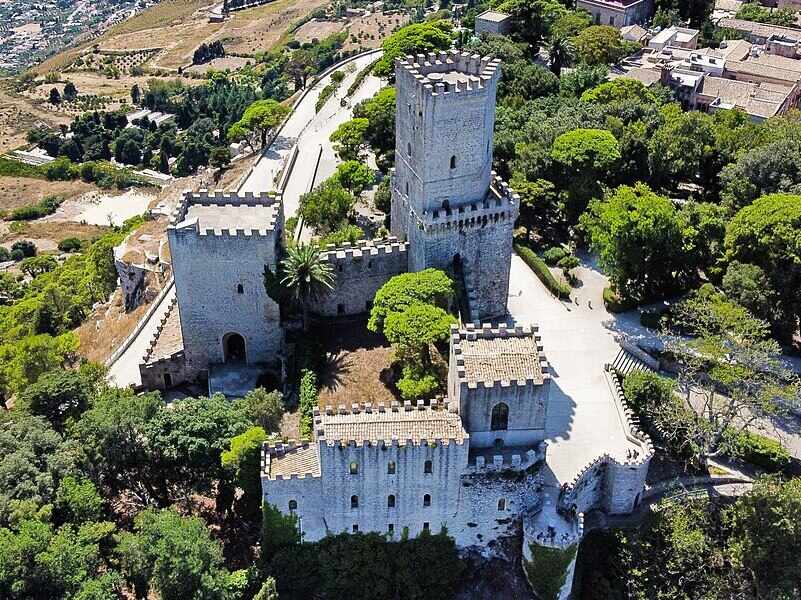
Erice is another world. At 750 metres above sea level, often wrapped in fog even in summer, with its medieval alleyways of white stone and that silence you don’t expect. The Castello di Venere – Norman, 12th century – was built on the ruins of a temple dedicated to the goddess of love, a pilgrimage destination from across the ancient Mediterranean.
From here you can see the entire western coast of Sicily, the Egadi Islands, the plain of Trapani, and on clear days even Tunisia. It is worth every hairpin bend of the cable car ascent.
- The battlemented walls and Norman bastions
- The view over the Egadi Islands and the plain of Trapani
- The medieval alleyways of Erice – unmissable
- The Giardini del Balio adjoining the castle
- Genovesi ericine – shortcrust pastry filled with milk cream. The recipe belongs to Maria Grammatico
- Trapanese fish couscous – the finest Arab tradition in the Mediterranean
- Trapanese pesto – almonds, tomato, basil, garlic. No parmesan

The castle of Castellammare del Golfo is one of those places that works perfectly within its landscape – it looks directly out to sea, at the centre of the marina, and seems made to stand exactly there. Arab origins from the 9th century, then expanded by Normans and Swabians. It has been everything: military outpost, route control, symbol of the town.
Today it houses the Museum of the Sea and the surrounding area is the most beautiful seafront promenade in the province of Trapani. Stay for dinner.
- The access bridge and the main tower
- The Museum of the Sea inside
- The “queen’s pool” – the surrounding stretch of water
- The seafront promenade at sunset
- Tuna from Bonagia – raw, in sweet and sour or grilled. Tuna is at home here
- Pasta with cuttlefish in black ink – made as the fishermen always have
- Amberjack in acqua pazza with Pantelleria capers

We close with the most melancholic stop on the tour. The Castello di Calatubo can be seen from the A29 motorway, on that rocky crag that looks like an apparition. Many mistake it for an old monastery or a farmhouse. Few stop. It is in a state of abandonment, and that is precisely what makes it so moving: those walls have resisted for centuries despite everything, waiting for someone to take care of them.
Below lie Hellenistic remains and an ancient necropolis. The history of this place goes much further back than it appears.
- The exterior seen from the road – the perspective on the crag is extraordinary
- The remains of the Hellenistic necropolis
- The historic centre of Alcamo with its mother church
- The wineries of the Alcamo DOC zone
- Catarratto DOC Alcamo wine – fresh and mineral white, among the best of western Sicily
- Alcamo bread with extra virgin olive oil and salt – simple and perfect
- Oven-roasted lamb with potatoes and rosemary – the cooking of the territory, no frills
Practical Tips
What you learn when you live in Sicily and have already done this route, for you.
🕐 When to go
- March–June: ideal. Green landscape, mild climate, few crowds
- September–November: a perfect second choice, harvest season in full swing
- July–August: avoid the middle hours – the heat inside stone castles is intense
- Winter: unique atmosphere, some castles reduce their opening hours
🚗 Getting around
- A car is essential – Mussomeli, Calatubo and Caccamo cannot be reached otherwise
- GPS at all times, but brown road signs reliably indicate cultural sites
- Park outside historic centres – medieval villages have narrow streets
- The cable car to Erice departs from Trapani: very convenient, leave the car below
🎟 Tickets and opening hours
- Hours change seasonally – always check before you leave
- First Sunday of the month: many state sites are free
- Caccamo and Donnafugata: book online in high season
- Mussomeli and Calatubo have reduced hours: check with the local municipality
👟 What to pack
- Comfortable shoes with sturdy soles – castle floors are uneven
- A jumper for Enna and Erice – even in summer, it’s windy at altitude
- A small torch – some rooms and underground prisons are dark
- A water bottle: in inland areas, drinking fountains are not always guaranteed
📖 Before you leave
- Read up on the Normans in Sicily: it changes the way you look at the stones
- The Baroness of Carini poem is worth 20 minutes of reading before the visit
- Look up “Sicilian Vespers” to understand why Castello Ursino matters so much
- “Sicilia Beni Culturali” app by the Sicilian Region – updated map and hours
🍋 Eating along the way
- Eat in the villages near the castles, not at motorway service areas
- Morning markets are the best possible breakfast anywhere
- The cuisine changes radically from east to west: don’t expect the same dish twice
- The local wine of each province is always the right choice
“Every castle in Sicily is a question that was never answered. Who were they really? How did they live? What did they fear? Come and find out for yourself.”
Cover photo by depositphotos.com