Palermo Province · 720 m altitude
Piana degli Albanesi
Where Albania Meets Sicily
A medieval Albanian enclave perched above Palermo — where Byzantine liturgy, a 500-year-old language, and the finest cannoli in Sicily await.
The Story
A Village Frozen in the 15th Century
Driving up from Palermo, the landscape quietly shifts — pine forests, winding hillside roads — until a road sign stops you cold. It reads: Mirë se erdhët! You are not hallucinating. You have just entered one of Italy’s most remarkable communities.
In 1488, Albanian refugees fleeing the Ottoman conquest of their homeland — following the death of their national hero, George Castriot Skanderbeg — landed on the Sicilian coast and were granted permission to settle by the Archbishop of Monreale. They founded Piana degli Albanesi and, remarkably, never left behind their language, faith, or traditions.
What you find today is not a museum recreation. It is a living, breathing community that has preserved a medieval Albanian dialect, a Byzantine Catholic liturgy, and centuries-old folk costumes — in the middle of Sicily.
The welcome sign is written in Arbëreshë — the local language. Take a photo, but more importantly, try saying “Mirë se erdhët” to a local. The reaction will be warm and immediate.
Language
A Language That Outlived Its Homeland
Arbëreshë is not modern Albanian. Linguists describe it as a living fossil — a 15th-century form of Albanian that has survived almost unchanged for over five centuries, while the language back in Albania evolved beyond recognition. Older residents speak it fluently; younger generations are working passionately to keep it alive.
Bilingual street signs are everywhere, blending Italian and Arbëreshë side by side — a small, stubborn act of cultural defiance that has persisted for generations. Local schools now teach the language to children.
If you speak modern Albanian, you may recognise words here and there — but this is a distinctly different, older form of the language. Locals will appreciate any genuine curiosity about its remarkable survival.
The Old Quarter
Sheshi: Open-Air Museum
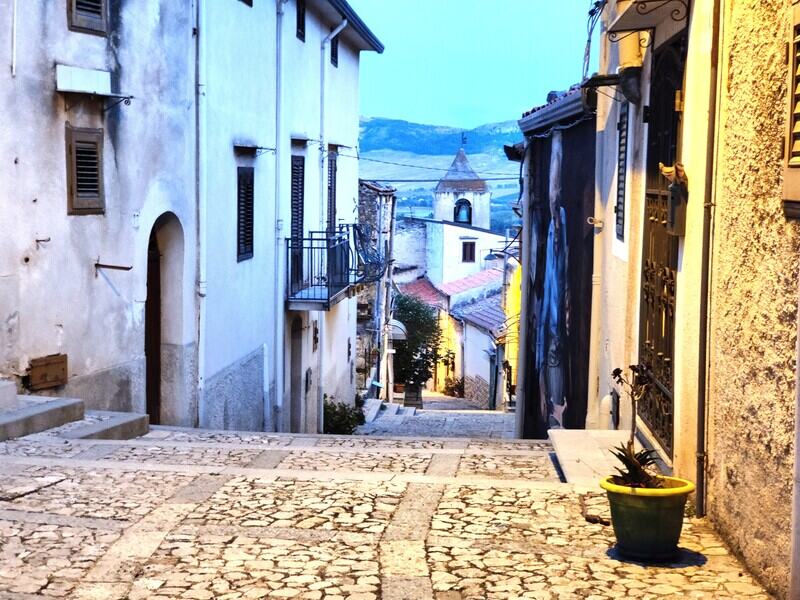
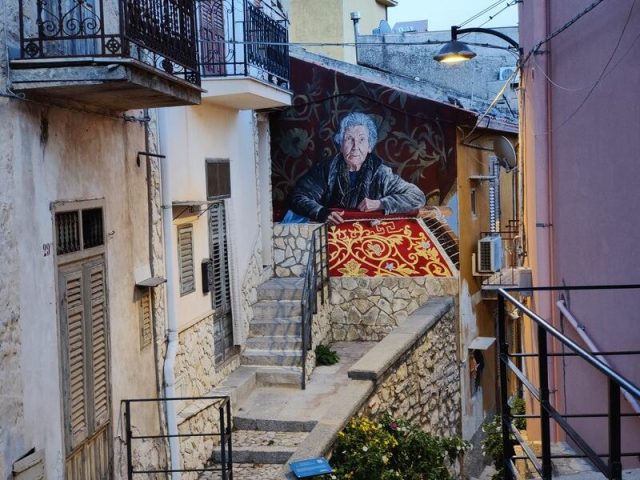
The Sheshi district is the oldest part of the village — the very ground on which the Albanian refugees first built their homes in 1488. A sensitive conservation project has restored the quarter and filled its walls with striking works of urban art, turning the narrow lanes into a walk through both history and contemporary expression.
Strolling through Sheshi is the best way to understand how the settlement originally grew — the compact scale of the streets, the way houses pressed close together for warmth at 720 metres, the relationship between the buildings and the hillside. Unhurried is the only sensible pace.
Faith & Ceremony
Byzantine Catholicism in the Heart of Sicily
The community belongs to the Greek-Byzantine Catholic rite — fully in communion with Rome, but following Eastern Orthodox liturgical traditions. Mass is celebrated in Ancient Greek and Arbëreshë, with unaccompanied choral singing that sounds as though it has drifted in from Constantinople. Priests wear Eastern vestments; the altar is shielded from the nave by an elaborately gilded iconostasis.
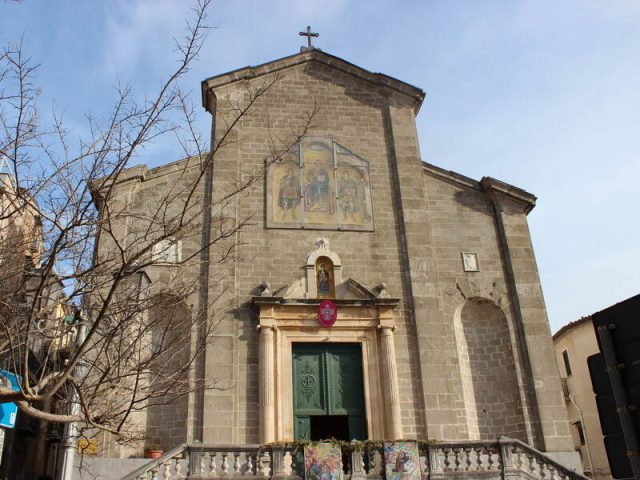
The Cathedral of San Demetrio Megalomartire is the heart of the community’s spiritual life. Step inside quietly, let your eyes adjust to the golden half-light of the icons, and allow yourself to be genuinely transported.
Remove hats and dress modestly when entering any of the churches. Photography may be restricted during services — always ask first. The interior atmosphere is genuinely meditative; rushing is inadvisable.
Unmissable Event
Easter: Sicily’s Most Spectacular Festival
If you can only visit once, time it for Easter. Nothing else in Sicily — arguably in Italy — compares to the visual spectacle of Piana degli Albanesi during Holy Week.
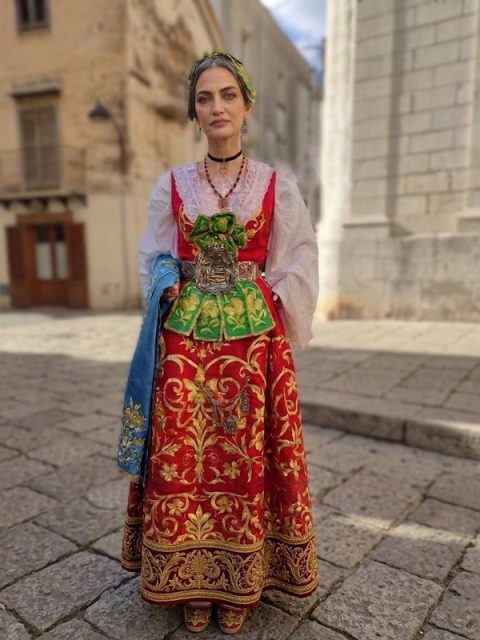
On Easter Sunday, women appear in the full grandeur of their traditional Arbëreshë costumes: layered gowns of silk and velvet embroidered in gold and silver thread, elaborate headdresses, antique jewellery passed down through generations. The colours — crimson, cobalt, emerald, gold — are staggering.
Women distribute red-dyed eggs (symbol of Christ’s blood and resurrection) to the crowd. Photographers travel from across Europe specifically for this event.
Book accommodation in Palermo well in advance. Arrive by 9am on Easter Sunday — the streets fill quickly. Dress respectfully; you are attending a religious event, not a performance.
What to See
Places Worth Your Time
Cathedral of San Demetrio
The community’s spiritual centre. The golden iconostasis and Byzantine frescoes are extraordinary. Silently absorb the atmosphere.
Fontana dei Tre Cannoli
The monumental three-spout fountain at the heart of the historic centre, flanked by the Church of the SS. Odigitria.
Sheshi Quarter
The oldest part of the village, restored and now an open-air urban art museum. Walk it slowly to understand the town’s origins.
MUSARB Museum
Housed in a former oratory. Sections on traditional costumes, Byzantine rite, and documentation of the 1947 Portella della Ginestra massacre.
Portella della Ginestra
The site of the 1947 massacre of peasant workers — a sobering, important memorial to one of postwar Italy’s darkest episodes.
Monte Pizzuta
At 1,333 m, it dominates the landscape. The Riserva Naturale Serre della Pizzuta offers excellent trekking trails and the hidden Grotta del Garrone.
Start at the Viadotto Tozia for panoramic views over the historic centre and lake, walk into the old town via Piazza dei Tre Cannoli, then wind up through the Sheshi quarter. Allow two to three unhurried hours on foot.
Nature & The Outdoors
The Lake and the Mountain
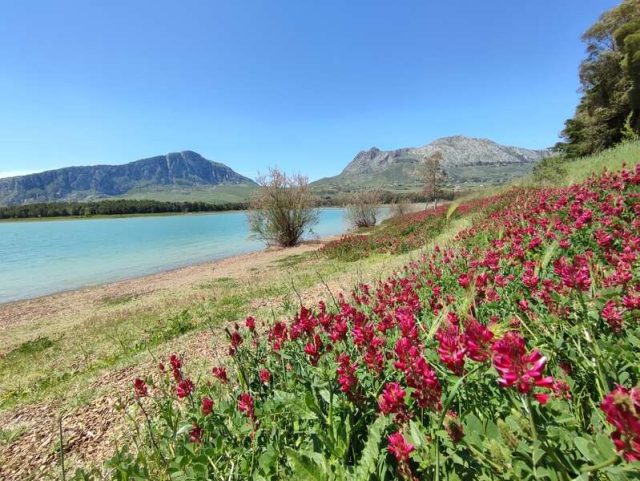
The territory around Piana degli Albanesi is rewarding for anyone who enjoys being outside. The lake — one of Sicily’s largest artificial reservoirs, created by damming the Belice Destro river in the 1920s — sits in a bowl of Mediterranean scrubland with views that stop conversations. It is an excellent base for walking and cycling.
Monte Pizzuta rises above the village to 1,333 metres. On one flank lies Portella della Ginestra; on the other, the trail network of the Riserva Naturale Serre della Pizzuta leads to the Grotta del Garrone — a cave known mainly to local hikers, well worth seeking out.
Food & Drink
Eat Well Here — This Is Not a Drill
The cuisine of Piana degli Albanesi is an honest, peasant tradition rooted in the surrounding farmland. Everything benefits from being close to the source.
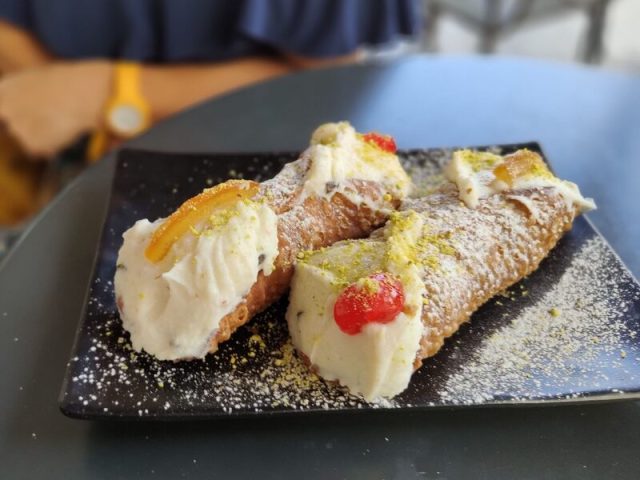
The local claim is bold: the best cannoli in Sicily, which is another way of saying the best in the world. Fresh sheep’s milk ricotta from local farms makes all the difference. Do not leave without one.
Sheep graze on the slopes of the Sicani Mountains, producing milk of exceptional quality. Buy fresh ricotta directly from a producer or farmhouse dairy if you can.
Wood-fired bread made with simple, honest ingredients. Locals still bring it as a house gift. Find it at one of the village bakeries — the smell alone justifies the detour.
Aged sheep’s cheese from the surrounding farms. Ask at any local deli or market stall. It travels well — bring some home.
Plan Your Visit
When to Go
The festival of a lifetime. Book accommodation in Palermo months ahead.
Lush landscape, wildflowers, lake full, mild temperatures. The ideal relaxed visit.
Warm but manageable at altitude. Quieter than the coast. Good for hiking.
Atmospheric mist and possible snow. Romantic and solitary. Some businesses closed.
24 km from Palermo. By car: take the SS 624 towards Sciacca, exit at Altofonte and follow signs, or continue to the dedicated Piana degli Albanesi exit. By bus: regular services from Palermo Centrale station. Journey approximately 45–55 minutes.
Welcome — and do come. You will not regret it.