
Arab-Norman Palermo is one of those places you don’t expect. You walk into a church and find yourself facing golden Byzantine mosaics, a ceiling carved by Arab artisans, and an architectural layout conceived by the Normans. All in the same building. All in perfect harmony.
This heritage was recognised by UNESCO as a World Heritage Site in 2015 and has since attracted travellers from around the world — many of whom find themselves overwhelmed: too many monuments, scattered across different parts of the city, with different opening hours and ticket prices. Where do you even begin?
This guide was created for exactly that reason: to help you plan your visit in a practical, stress-free way, without missing anything important.
What is the Arab-Norman UNESCO itinerary?
To understand what you’re about to visit, a step back in history is needed. Between the 9th and 11th centuries, the Arabs dominated Sicily and turned Palermo into one of the wealthiest and most populated cities in the Mediterranean. When the Normans arrived in the late 11th century, they didn’t destroy anything — instead, they took the best of Arab culture, blended it with Byzantine traditions, and added their own architectural taste.
The result is the Arab-Norman style, unique in the world. Churches with red domes that look like mosques, interiors covered with golden mosaics, palaces with fountains and pleasure gardens. Nothing like it exists anywhere else.
The UNESCO itinerary comprises nine sites across Palermo, Monreale, and Cefalù.
The nine UNESCO monuments: what to see and in what order
1. Palazzo dei Normanni and the Palatine Chapel

Start here — there’s no discussion. The Palazzo dei Normanni is the heart of it all: an Arab fortress in the 9th century, then transformed by the Normans into their royal residence. Today it houses the Sicilian Regional Assembly, but the historic halls and inner courtyards are open to visitors.
Inside lies the Palatine Chapel, which Guy de Maupassant called “the most beautiful church in the world”. He wasn’t wrong. The Byzantine mosaics are made of real gold, the muqarnas ceiling is a masterpiece of Fatimid craftsmanship unique in the world, and the polychrome marble floor is the work of Arab craftsmen.
Practical tip: Arrive early — ideally at 8:30 AM when it opens. Allow at least 90 minutes for the full visit.
2. San Giovanni degli Eremiti

Just a short walk from the Palazzo dei Normanni. The five red domes of San Giovanni degli Eremiti are perhaps the most iconic image of Arab-Norman Palermo. The church was built in the 12th century on an earlier Arab building, and its cloister with its little garden is one of the most peaceful corners you’ll find in the city centre.
Practical tip: Visit takes 30–40 minutes. Free on the first Sunday of the month.
3. The Cathedral

Walking up towards Corso Vittorio Emanuele, you’ll reach Palermo Cathedral — a building that condenses the city’s entire history in one structure: Roman temple, early Christian basilica, Arab mosque, Christian church. Don’t miss climbing to the Cathedral rooftops for a breathtaking view of the historic centre.
Practical tip: Free entry to the church itself. Tickets required for the rooftops, royal tombs, and treasury. Allow at least one hour.
4. Piazza Bellini – La Martorana and San Cataldo

Ten minutes on foot along Via Maqueda brings you to Piazza Bellini, where two gems stand side by side. La Martorana (founded 1143) houses some of Sicily’s oldest Byzantine mosaics. Right next door, the Church of San Cataldo is the purest example of Arab architecture in service of the Normans — three little red domes, blind arcades, and a stripped-down interior.
Practical tip: Both churches can be visited with a combined ticket in under an hour.
5. Palazzo della Zisa
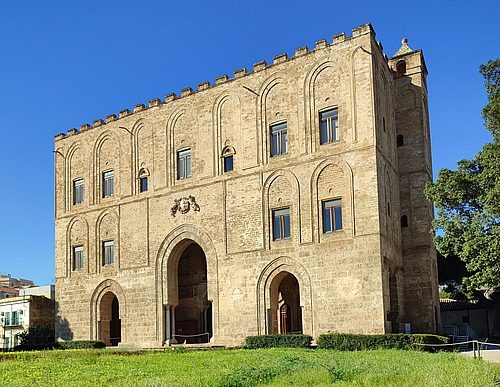
A short detour from the centre, but well worth it. The Palazzo della Zisa — from the Arabic al-‘Azīza, “the magnificent” — was the Normans’ summer residence. Today it houses the Museum of Islamic Art.
Practical tip: About 20 minutes on foot from Piazza Bellini. Visit takes around 45 minutes. Free on the first Sunday of the month.
6. Ponte dell’Ammiraglio
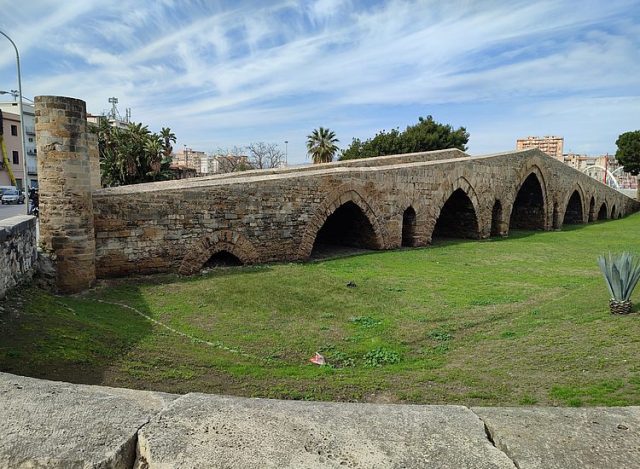
Located in the southern outskirts along Corso dei Mille. This 1131 bridge connected the city to gardens beyond the Oreto river. Its pointed arches allowed it to bear enormous loads — it even survived the devastating 1931 flood. It is also the site where Garibaldi’s troops fought the Bourbons in 1860.
Practical tip: Free and always accessible. Especially atmospheric in the late afternoon light.
7. Monreale: the Duomo and cloister

If Palermo’s heritage is spread across multiple sites, in Monreale everything is concentrated in one go. The Duomo di Monreale is, after Hagia Sophia in Istanbul, the largest existing Byzantine mosaic work: around 6,400 square metres of golden mosaics covering the walls from top to bottom. The Christ Pantocrator in the apse is arguably the most sublime representation of Christ in Christian art.
Practical tip: Monreale is about 8 km from central Palermo. Take bus 389 from Piazza Indipendenza (about 25 minutes). Dedicate half a day to the visit. Cloister free on the first Sunday of the month.
8. Cefalù: the cathedral
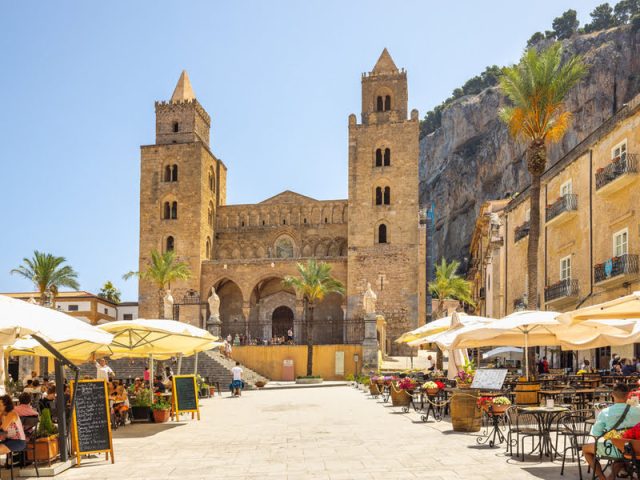
The Cathedral of Cefalù, commissioned by Roger II in 1131, is one of the most perfect examples of Southern Romanesque architecture. The facade with its two corner towers is unmistakable, but it’s the interior that takes your breath away: the Christ Pantocrator in the apse, on a golden background, is of a beauty that leaves you speechless.
Practical tip: Cefalù is about 70 km from Palermo. Best reached by train (about one hour) from the Central Station. Worth dedicating a full day, combining the cathedral with a stroll through the village and perhaps a swim. Free entry to the church; tickets required for the Towers, Cloister, and Museum.
How to organise your visit: suggested itinerary
If you have one day (walking tour of the centre)
Palazzo dei Normanni + Palatine Chapel – 1h 30min
San Giovanni degli Eremiti – 30 min
Cathedral (with rooftops) – 1h
La Martorana + San Cataldo – 45 min
Palazzo della Zisa – 45 min
Total walking distance: approx. 4.5 km. Start at 8:30 AM, finish in the early afternoon.
If you have two days
Day 1: city centre itinerary as above + Ponte dell’Ammiraglio in the late afternoon.
Day 2: half a day in Monreale (morning) + free afternoon to explore additional sites.
If you have three days
Add a full day in Cefalù and explore lesser-known sites in Palermo: La Cuba, Castello di Maredolce, and the mysterious underground Qanat
Tickets and savings
First sunday of the month: many regional sites (San Giovanni degli Eremiti, Zisa, Cuba, Maredolce) are free
No official combined ticket exists for all nine UNESCO sites. Each monument has its own ticket office.
Palatine Chapel: the most expensive site, but worth every penny.
Churches (Cathedral, Martorana, San Cataldo): small contribution or free.
When to Visit
The good news is this heritage can be visited year-round. Off-season months — October to March — offer a huge advantage: fewer crowds, same beauty. Winter light in Palermo is soft and warm, making the golden mosaics even more luminous. Temperatures rarely drop below 10°C even in January.
In summer, start early in the morning, bring water, a hat, and comfortable shoes.
Hidden Gems: Sites Most Tourists Don’t Know
Beyond the nine main monuments, the Arab-Norman itinerary includes thirteen additional sites that deserve a visit:
The Qanat: underground channels built by the Arabs to carry water from springs to the city’s gardens. After a thousand years, the water still flows. Visits by appointment through the CAI Palermo.
Castello di Maredolce: a palace once surrounded by an artificial lake, a true oasis at the city’s gates.
La Cuba: a pleasure pavilion in the great royal park of the Genoardo, with a perfect form recalling the palaces of North Africa.
