
Let me be straight with you: you cannot truly understand Palermo without stepping inside its churches. And I don’t mean a quick peek through the door before rushing off to the Ballarò street market. I mean stopping, looking up, and letting all that extravagance wash over you. Because Palermo’s baroque is not just an architectural style — it’s a statement. It’s a city telling you, in gold and marble and stucco, look at how big we dare to dream.
In the 17th and 18th centuries, Palermo was one of the wealthiest and most densely populated cities in the entire Mediterranean. Noble families, religious orders and lay confraternities competed with one another, each trying to build a more magnificent, more dramatic, more breathtaking church than the last. The result? A baroque heritage that would put many European capitals to shame — and which, somewhat remarkably, the Palermitans themselves often take for granted.
If you have a few days in the city, here are the churches you simply cannot miss.
The Church of the Gesù, known as Casa Professa

Start here. If I had to take someone to see just one thing in Palermo, this would be it. We are right in the heart of the Albergheria neighbourhood, a stone’s throw from Ballarò market, and even from the outside the church commands attention. But it’s what happens inside that defies description.
The Jesuits, who began building it in 1564, were not ones for half-measures: they wanted every single centimetre of the walls covered in decoration. And they pulled it off magnificently. What you see is an extraordinary work in coloured marble inlay — the famous Sicilian marmi mischi — unlike anything you’ve seen before. It’s not heavy, it’s not gaudy: it’s a mosaic of stone that at times looks almost embroidered. Deep reds, bottle greens, and ochre yellows follow one another in a rhythm that never grows tiresome. You could spend an hour in here and keep finding new details.
A practical tip: go in the morning, when the light streams through the side windows and the marbles seem to glow from within.
The Church of Santa Caterina
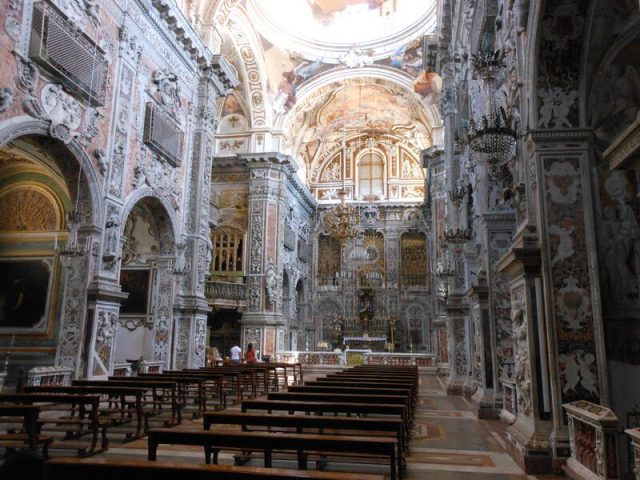
Overlooking Piazza Bellini — the same square that hosts La Martorana and San Cataldo — Santa Caterina is perhaps the best-kept secret among Palermo’s great baroque churches. For many years it stayed closed and largely unvisited. It’s open now, and visitors are finally discovering what’s been hiding inside.
And what’s inside is simply one of the most beautiful interiors in all of Sicily. The Dominican nuns who lived here for centuries took a deeply personal interest in enriching the church, and the result is a decoration that covers literally every surface: white stucco, inlaid marble, brightly coloured frescoes, statues of saints that look as though they might step off their pedestals at any moment. There is something distinctly feminine about this church — a passion for detail, an almost obsessive commitment to beauty — that sets it apart from everything else.
Above it all, the frescoed dome opens up towards a sky crowded with angels. Tilt your head back and stay a while.
The Church of San Giuseppe dei Teatini
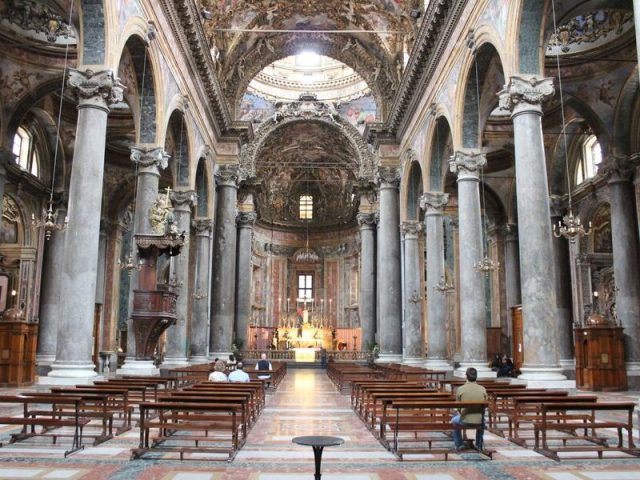
This church occupies one of the most strategic positions in the city, making it impossible to overlook: it stands at the Quattro Canti, the octagonal crossroads that divides Palermo’s historic centre into four districts. It is, quite literally, the geometric heart of the city.
The Theatines built it during the 17th century, and they built it big — very big. The interior follows a Latin cross plan with an exceptionally tall central nave, and there is a grandeur here that many other Palermitan churches, richer in ornament but stingier with space, simply cannot match. The place breathes. The columns are enormous, the capitals elaborately carved, and the dome — barely visible from the outside, tucked behind the rooftops — reveals itself on the inside as a sweeping fresco of Paradise that alone is worth the visit.
The Theatines were a serious, scholarly order with an eye for quality, and it shows. This is not a church built to impress — it is a church built for prayer. But prayer dressed in marble.
The Church of San Domenico

Known for good reason as the “Pantheon of the Sicilians”, San Domenico is where Palermo chose to bury its great men and women: poets, painters, jurists, heroes of the Risorgimento. Plaques and funerary monuments line every wall, and walking along the side aisles feels a little like leafing through a history book of the island.
But San Domenico is also, and above all, a first-rate baroque gem. The façade — added in the 18th century — is among the most elegant in Palermo: white, clean, almost restrained compared to the interiors of other churches, flanked by two symmetrical bell towers. The inside is more austere than you might expect, but it carries a quiet dignity that stays with you.
In front of the church lies one of the loveliest squares in the historic centre, with a column of the Immaculate Conception at its heart. Sit on one of the benches and look at the façade: it’s one of those moments that reminds you exactly why you travel.
The Church of Santa Teresa alla Kalsa
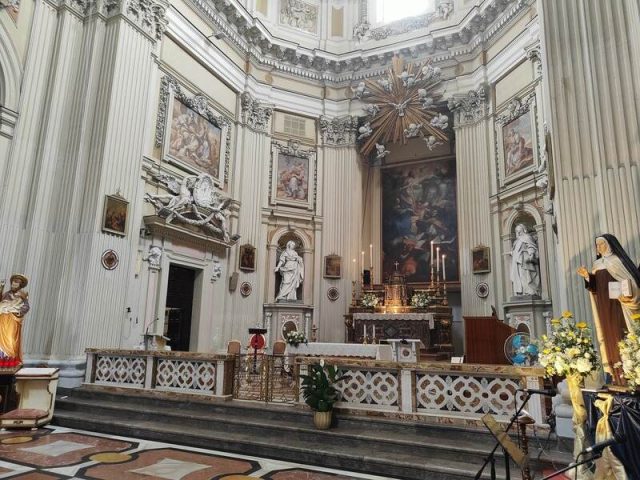
The Kalsa neighbourhood is one of Palermo’s oldest — the Arabic quarter, the one that bore the brunt of World War II bombing raids and that still carries the scars of a reconstruction that was never quite finished. In this neighbourhood of contradictions — crumbling noble palaces standing next to newly regenerated public spaces — you’ll find Santa Teresa, a church that is in many ways a symbol of the whole story.
It was built in the second half of the 17th century for the Discalced Carmelite nuns, and its white limestone façade stands out all the more sharply in a neighbourhood that still feels, in places, like it is waiting to be rediscovered. The interior preserves attractive stucco decoration and several good-quality canvases, but it is above all the atmosphere — intimate, quiet, slightly melancholic — that makes it special.
This is a church best visited in the afternoon, when the light shifts and the neighbourhood around it slowly comes to life.
The Oratories of Giacomo Serpotta: baroque in stucco

No visit to Palermo’s baroque churches is complete without talking about Giacomo Serpotta, the sculptor who, at the turn of the 17th and 18th centuries, invented a distinctly Palermitan way of doing baroque. Instead of marble — expensive and heavy — Serpotta worked in stucco, which he shaped with such extraordinary skill that his figures seem almost to breathe.
The places where this genius is best expressed are not the churches themselves, but the oratories of the lay confraternities: small meeting rooms where Serpotta could work without constraints. The three you absolutely must not miss are the Oratory of the Rosary of Santa Cita, the Oratory of the Rosary of San Domenico, and the Oratory of San Lorenzo — the last of these sadly famous as the former home of Caravaggio’s Nativity, stolen in 1969 and never recovered.
In these spaces, Serpotta scattered hundreds of putti and allegorical figures that seem to be playing among themselves — clambering over cornices, peering round corners, laughing. There is something festive, almost pagan, about this Sicilian baroque, as though the joy of living had found a way to sneak even into sacred space.
Before You Go: A Few Practical Tips
Palermo’s historic centre is not large, and many of these churches are within a twenty-minute walk of one another. The best way to visit them is to plan a route through the four historic districts — Albergheria, Capo, Vucciria and Kalsa — weaving churches together with markets, piazzas and alleyways.
Watch the opening hours: many churches are only open in the morning or close in the afternoon. Some charge an entry fee, others are free or ask for a donation. Santa Caterina in particular has hours that change by season, so it’s worth checking ahead.
And finally: don’t rush. Palermo’s baroque is not something you consume quickly, and it was not made to be photographed and left behind. It was made to be experienced — even if that just means sitting on a wooden pew and looking up at the frescoed dome that has been waiting for you for centuries.
