
The Royal Palace of Palermo, also known as the Palazzo dei Normanni, is the oldest royal residence in Europe. Its history is intertwined with the political and cultural evolution of Sicily. It is a place where different cultures and architectural styles have converged over more than two thousand years, creating a unique and fascinating monument.
The Royal Palace of Palermo: a history of many eras

The site was first used by the Phoenicians as a trading post. They built a fortified structure which may be the first nucleus of what would become the Palace. After the Phoenicians, the Greeks, Romans and Byzantines occupied the site. In 837, the Arabs conquered Sicily and built their fortress here called El Qasr, which gives the name to the area, “Cassaro”. In the 11th century, the Normans arrived, making the castrum superior their royal residence.
The Norman era
King Roger II of Normandy was the main force in transforming the fortress into a royal palace in the 12th century. He commissioned many buildings and extensions in Arab-Byzantine style. This period was one of great splendor, attracting the admiration of visitors. The palace complex included:
- Four towers connected by walkways
- A large courtyard with the Royal Chapel at the center
- A mint and a Tiraz, a workshop for producing luxury goods
The original layout of the palace is difficult to reconstruct, as it has been modified over the centuries.
Later history
After the Normans, the Palace was used by Frederick II of Swabia, who created a cultural center. Later the palace was abandoned, then used by the Spanish viceroys, who made significant changes. In the 16th century, the palace was expanded and many older structures were either destroyed or incorporated into new buildings. The palace was modified by the Bourbon rulers in the 19th century. In the 1800s, it was assaulted by rioters and sustained damages.
The Palace Today Today, the Palazzo dei Normanni is the seat of the Sicilian Regional Assembly. Despite numerous alterations, it still holds much of its original charm.
Key features of the Royal Palace of Palermo
The Palatine Chapel (Cappella Palatina): A masterpiece of Byzantine style, adorned with mosaics and recognized as one of the best-preserved medieval jewels in the world. It was built on a pre-existing church and dedicated to Saint Peter. The chapel’s mosaics display scenes from the Old and New Testaments. The wooden ceiling reveals Islamic influences with its muqarnas decorations. The chapel exemplifies the tolerant policies of Roger II.
The Pisana Tower: The oldest and best preserved part of the complex, it is a survivor of the Arab architectural style. Its geometric design and light-and-shadow effects are characteristic of the era. The “Treasure Room” is on the ground floor and the upper floor was once decorated with mosaics. Today, it houses the offices of the President of the Regional Assembly.
The Sala di Ruggero: Located in the Joharia tower, it is decorated with mosaics representing hunting scenes and exotic animals.
The Sala dei Venti: Also in the Joharia tower, it has a wooden ceiling with a wind rose at the center. It originally had an open space in the center, but is now covered.
The Sala d’Ercole: This is where the Sicilian Regional Assembly meets. It is named for the paintings of the mythological hero Hercules completed in the early 19th century.
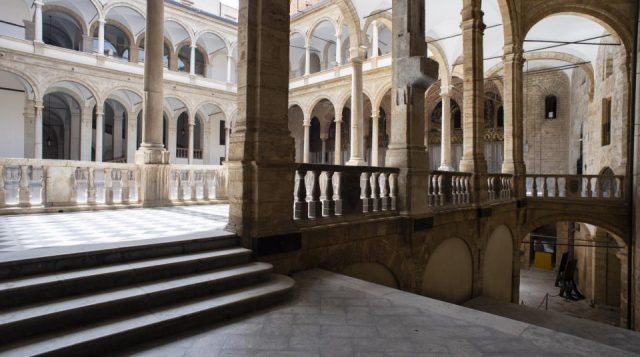
The Maqueda Courtyard: Built in 1600, it was commissioned by the Duke of Maqueda.
Highlights for visitors
The Royal Palace of Palermo is a must-see destination for anyone interested in history, art, and culture. It’s a place where you can trace the fascinating history of Palermo and Sicily. It is also part of the Arab-Norman UNESCO World Heritage Site.
For information about visiting hours and costs, you can check the website of the ⎆Fondazione Federico Secondo
Enjoy your visit to this incredible monument!
