
Siracusa is a fascinating city on the southeast coast of Sicily, Italy, often considered a “living history book”. Once a powerful city in the ancient world, even rivaling Athens, it was the birthplace of the famous mathematician Archimedes. Its historic center, including the island of Ortigia, and its archaeological park are UNESCO World Heritage sites. While a single day offers a “taste” of the city, a weekend visit is recommended to appreciate every detail.
Siracusa’s history is rich and diverse, having been founded by Greeks in the 8th century BC and later influenced by Romans, Byzantines, Arabs, Normans, and Spaniards. This cultural blend results in a landscape of ancient ruins, Baroque palaces, and stunning churches, narrating a story spanning over 2,700 years. The city boasts a Mediterranean climate with hot, humid summers and mild winters, making spring and autumn ideal times to visit. Always wear comfortable shoes and carry water, a hat, and sunscreen, even in late spring. When visiting churches or religious sites, remember to cover your shoulders and knees out of respect; a light scarf can be useful.
Siracusa is a very safe and welcoming city, even at night, especially Ortigia, which is well-lit. Compared to other major European cities, Siracusa is quite affordable, with reasonably priced meals and many free attractions. The currency is the Euro (€), and while most places accept cards, it’s good to have some cash. Be aware that many shops, especially smaller ones, close for a few hours in the afternoon for a “siesta,” so plan your shopping accordingly.
Your Siracusa Weekend Challenge Itinerary
Day 1: Ortigia – The ancient heart of Siracusa
The first day is dedicated to Ortigia, the island that forms the historic core of the city. Though it’s called “u scogghiu” (the rock) by locals, it’s connected to the mainland by two bridges, making it feel like entering another world. It’s highly walkable, with a beautiful waterfront, narrow alleys, charming squares, ancient palaces, and modern fountains.
Morning: A step back in time
Ponte Umbertino and Temple of Apollo: As soon as you cross the Ponte Umbertino, you’ll be transported to the past by the Temple of Apollo, the oldest Doric temple in all of Sicily, built in the 6th century BC. Despite its age and past uses as a church and even a mosque, it’s impressive to see it right in the city center. The area isn’t open to the public, but it’s easily visible from the street. The temple was notable for being the first to feature a stone peristyle.
Ortigia Market: A short walk away is the lively Ortigia Market, a vibrant explosion of colors and scents, where vendors call out “vanniata” (Sicilian cries to attract customers). Here, you can sample authentic Sicilian street food, from fresh fish to spiced dishes. The market is fully accessible with ramps, elevators, and wheelchair-friendly paths, and is open daily from 6:00 AM to 7:00 PM, with mornings recommended for a more lively experience.
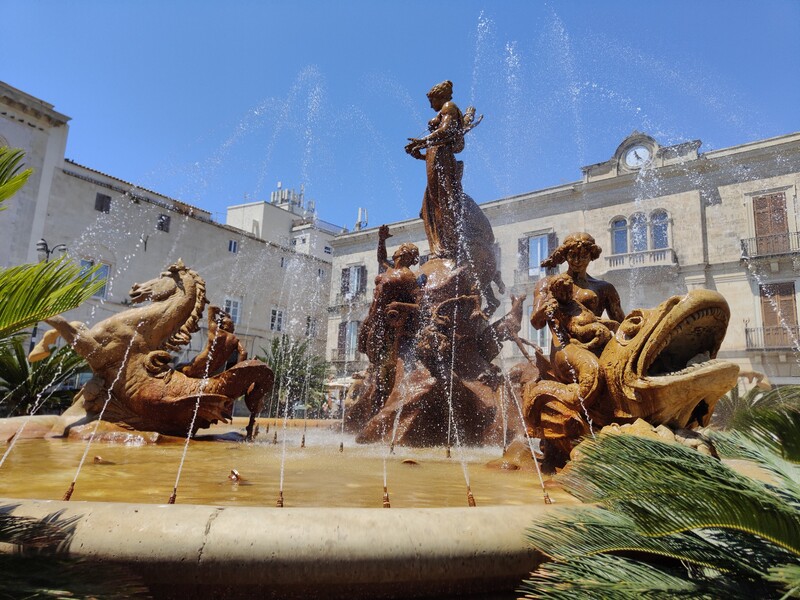
Piazza Archimede and Fountain of Diana: After the market’s hustle, head to the more elegant Piazza Archimede, surrounded by 19th-century buildings. In its center stands the spectacular Fountain of Diana, depicting the myth of the nymph Aretusa’s transformation. This monumental fountain, built in 1907, features Diana with her bow and dog, Aretusa transforming into a spring, and Alpheus watching.
Duomo and Piazza Duomo: A few steps further brings you to Piazza Duomo, considered one of Italy’s most beautiful squares, radiant with white Iblei stone. The Siracusa Cathedral (Duomo) is a unique masterpiece, built by incorporating an ancient Greek temple dedicated to Athena from 480 BC. The original Doric columns are still perfectly visible both inside and out. It has served as a temple, Roman church, mosque, and eventually the first Christian church in Europe. The Baroque facade is considered a masterpiece. Entry is generally free during opening hours.
Santa Lucia alla Badia and the Caravaggio Painting: Very close to the Duomo is the small Church of Santa Lucia alla Badia. Don’t be fooled by its simple exterior; inside, it holds an invaluable treasure: one of Caravaggio’s paintings from his time in Sicily. It depicts “The Burial of Saint Lucia,” the patron saint of Siracusa, martyred there in 304 AD. Caravaggio’s work was innovative for its time as it showed the burial rather than the saint’s martyrdom.
Lunch Break: Indulge in Siracusan specialties. Try fried pasta with anchovies and toasted breadcrumbs (anciova e muddica) or cavatelli with tuna bottarga and cherry tomatoes. You might also try an arancino al ragù, though here they have the masculine Catanese name and conical shape.
Afternoon: legends and coastal fortresses
Fonte Aretusa: For good digestion, take a stroll through the characteristic internal streets to the promenade leading to the Fonte Aretusa, a magical spot and symbol of Ortigia. This freshwater spring is unique in Europe because papyrus grows spontaneously here. Legend says the nymph Aretusa was transformed into a spring by Artemis to escape the love of the river god Alpheus. Poets and artists have been enchanted by this myth for centuries.
Castello Maniace: To conclude the day, walk along the picturesque Lungomare Alfeo to the Castello Maniace. This square-based fortress with cylindrical towers is a symbol of the power of Frederick II of Swabia, who had it built in the 13th century. It has a complex and not fully understood history, but its architectural details are still fascinating. The castle served many purposes, including a royal residence, prison, and barracks.

Day 2: ancient grandeur and modern faith
On the second day, venture outside Ortigia to explore the grandeur of ancient Greek Siracusa and a modern icon.
Morning: Neapolis Archaeological Park
The Neapolis Archaeological Park is one of the world’s most important archaeological complexes and a UNESCO World Heritage site. This vast area (240,000 square meters) can be explored in a couple of hours, allowing you to step back in time among Greeks and Romans.
Greek Theater: This is a highlight! The Greek Theater of Siracusa is one of the largest ancient theaters in the world, entirely carved into the rock, capable of hosting up to 15,000 spectators. Famous works like Aeschylus’s “The Persians” were first performed here. Even today, it hosts theatrical performances in the summer with exceptional acoustics.
Ear of Dionysius: Near the theater, you’ll find the Ear of Dionysius, an artificial cave with a unique shape that incredibly amplifies sounds. Legend says tyrant Dionysius I used it as a prison to secretly listen to his prisoners. Caravaggio named it.
Roman Amphitheater: The park also features a large Roman Amphitheater, a tangible testament to the presence of gladiators in Sicily, where combat spectacles and even aquatic shows were held. Much of its stone was used by the Spanish to build Ortigia’s defenses, but its layout is still recognizable.
Tomb of Archimedes: Within the park, you can see the (presumed) Tomb of Archimedes, the brilliant mathematician and inventor born in Siracusa, known for the legend of the burning mirrors used to defend the city during the Roman siege.

Lunch Break: You can have a quick lunch near the Archaeological Park or move towards the next stop.
Sanctuary of the Madonna delle Lacrime: This modern, monumental church has a unique conical design. It’s a pilgrimage site commemorating a miraculous event in 1953 when a plaster effigy of the Virgin Mary reportedly wept. It is generally open to visitors for prayer and visits.
Catacombs of San Giovanni and Crypt of San Marciano (Optional): If you have time and are interested in ancient history, these catacombs are nearby the Archaeological Park. They are one of the most extensive underground burial sites outside of Rome, originating from a Greek aqueduct and later used by Romans as a necropolis. A guided tour is mandatory.

Getting Around Siracusa
Ortigia: Moving around Ortigia is very easy on foot; everything is within walking distance.
Outside Ortigia: To reach the Archaeological Park and the Sanctuary, you can take a local bus, a taxi, or a tourist bus. Public buses are available but can be slow and infrequent, especially on weekends.
Car Rental: Renting a car is a good option for exploring outside the city, such as visiting Noto or the beaches of Fontane Bianche, and the coastal drive is scenic.
Bicycle or Scooter: For a fun and relaxed way to explore, you can rent a bicycle or scooter. Siracusa also has the Rossana Maiorca cycling path.
Boat Trip: Don’t miss the opportunity to take a boat trip around Ortigia to see the city from the water, which offers a beautiful perspective.
Sicilian flavors and local cuisine
A trip to Sicily is incomplete without experiencing its cuisine, which blends seafood and local produce from the Iblei Mountains.
Pasta Dishes: Try pasta with fried anchovies and toasted breadcrumbs (anciova e muddica) or cavatelli with tuna bottarga and cherry tomatoes.
Main Courses: For seafood, try tuna alla ghiotta (with potatoes, tomatoes, peppers, and onions, especially good in May when fresh tuna is available) or monkfish alla matalotta (with olives and capers). For meat, try fried rabbit (‘a stimpirata) with capers, white olives, cherry tomatoes, and celery, or meatballs (purpetti).
Sides: Taste caponata, an eggplant-based dish.
Desserts: Don’t miss Sicilian granita (especially almond granita from Avola, perhaps with a warm brioche) and Siracusan cassata (which here is made with sponge cake instead of glaze). Other almond-based sweets include frutta martorana and biscotti totò.
Wines: Siracusa boasts 24 Protected Designation of Origin (DOP) appellations, including Siracusa and Erolo wines.
Enjoy your trip to Siracusa, a magical city that combines history, art, culture, and breathtaking landscapes, offering a truly authentic Sicilian experience!
Useful Link:
- Parco archeologico di Siracusa – Viale Teocrito, 66 phone: 0931489511
- Castello di Maniace – Via Castello Maniace, 51 phone: 0931487248.
- Catacombe di San Marciano – Largo San Marciano, 3 phone: 093164694
- Basilica Santuario Madonna delle Lacrime – Via del Santuario, 33 phone 0931 21446
