Palermo’s street food is not merely a collection of dishes; it is considered a philosophy of life and a sensory experience that speaks of the city’s authentic soul. Many regard Palermo as the world capital of street food, a claim supported by prestigious magazines like Forbes, which ranked Palermo as the fifth best city globally for street food and the only Italian city on the list.
The deep roots of Palermitan cuisine reflect its rich history, where numerous dominations – including Greek, Roman, Arab, Byzantine, Spanish, and French – contributed to its vast gastronomic variety. This fusion of customs and cultures has shaped a unique culinary identity, particularly evident in its “poor cuisine” that transforms humble, locally sourced ingredients into extraordinary delights.
Historically, street food served to feed farmers, then workers, and finally merchants, with recipes passed down through generations over centuries. Today, it has experienced a “second youth”, evolving into a global phenomenon while still retaining its authentic character. While modern establishments offer traditional recipes in cleaner, more fashionable settings, the true street food experience involves getting your hands dirty and engaging with vendors in a universal language of gestures and appreciation. This culinary tradition fosters a strong social value, as it’s often enjoyed standing among crowds, “eating the territory” itself. Unlike global fast-food chains that centralize profits, Palermitan street food actively boosts the local economy.
Here are some of the must-try specialties that define Palermo’s vibrant street food culture:
L’ Arancina: The fried Queen

The undisputed queen of Palermitan street food is the Arancina (female, as pronounced in Palermo). This fried rice ball, with its crispy golden crust and tender, flavorful interior, resembles a large orange, a clear legacy of Arab culture.
Classic Versions: The most traditional “accarne” (with meat) version features a red ragù of minced meat with peas and saffron-tinted rice. The “al burro” (with butter) variant includes prosciutto and mozzarella or béchamel.
Other Variations: You can find arancine with spinach, mushrooms, and even sweet versions filled with chocolate, then coated in sugar and cinnamon.
Cultural Significance: Arancine are deeply beloved, especially on December 13th, Saint Lucia’s Day, when Palermitans abstain from bread and feast on arancine as a sign of devotion. They are widely available in bars, fry shops (friggitorie), and rotisseries (rosticcerie).
How to make authentic Sicilian Arancine at home
Pane e Panelle… e Crocchè: The crispy symbol

Another pillar of street food is Pane e Panelle. Panelle are simple, small, golden-fried fritters made from chickpea flour, water, salt, and parsley. They are crispy on the outside and tender within, typically served hot with salt and a squeeze of lemon inside a soft mafaldina or muffoletta bun. This is a quick, practical, and affordable food embodying the true spirit of street food.
Often, Crocchè (locally known as “cazzilli”) accompany panelle in the sandwich. These are elongated potato croquettes made from mashed old potatoes, seasoned with parsley or mint, and fried in the same abundant oil used for panelle, achieving an irresistible golden hue. The ritual of consuming “Pane, Panelle e Crocchè” involves visiting a local “panellaro” (panelle vendor) or a wandering vendor with their “lapa” (Piaggio Ape van).
Rascatura: The ingenious recycle

Rascatura literally means “scrapings”. It’s a testament to Palermitan culinary ingenuity, made by combining the leftover batter from panelle and crocchè production, sometimes with added cheese, and then fried. Its shape is similar to a crocchè but rougher and darker in color. It’s a flavorful, intense dish, showcasing how Palermitan cuisine transforms “scraps” into delicacies.
Calamari Fritti: The taste of the sea in a sandwich
For seafood lovers, Calamari Fritti are a must-try. These are perfectly fried rings and tentacles of squid, crispy and flavorful, which can be eaten on their own or to fill a sandwich. They are often served with a squeeze of lemon and aromatic herbs. You can find them in traditional fry shops or fish markets like Vucciria, Ballarò, or Capo.

Fritturiedda: The mixed fried seafood
Another classic for on-the-go enjoyment is Fritturiedda, a paper cone filled with fried fish. It typically consists of small blue fish, baby squid, cuttlefish, shrimp, and sometimes sardines, all heavily floured and fried in hot oil. It’s a simpler version of the “fritto di paranza” common in other Italian regions. It’s served in a classic “coppo” (rolled paper cone) and must be eaten immediately, hot and fragrant, perhaps with a touch of lemon. You can find it in fish fry shops or markets near the sea.
Pane ca Meusa: the bold and fatty delight

For the adventurous, Pane ca Meusa (sandwich with spleen) is an unmissable, bold flavor experience. It’s one of Palermo’s most recognizable traditional foods, born from the need to utilize less noble parts of the calf. It consists of a soft bun filled with pieces of calf spleen and lung, often with other offal, first boiled and then sautéed in lard in a large cauldron. It can be enjoyed in two ways: “schiettu” (single), simply with a squeeze of lemon, or “maritatu” (married), enriched with abundant grated caciocavallo cheese or fresh sheep’s milk ricotta.
Its invention is attributed to Jewish butchers, who, forbidden from accepting monetary compensation, received offal as payment and created this dish for Christians to eat with bread for a quick meal. The “meusari,” specialized vendors, are easily identified by their steaming cauldrons.
Sfincione Palermitano: The spongy focaccia

Sfincione is a tall, incredibly soft focaccia, so tender it melts in your mouth, almost like a sponge. It’s generously topped with tomato sauce, stewed onions, oregano, caciocavallo cheese, anchovies, and breadcrumbs. Sometimes capers or olives are added. It is a complete meal, perfect for breakfast, a snack, or a quick lunch. You’ll hear the traditional call (“abbanniata”) of vendors: “Cchi ciavuru! Uora u’ sfuinnavu, uora!” (What a smell! I just took it out of the oven, now!).
Vendors, known as “sfincionari,” often use modified Piaggio Ape vans (“lapino”) equipped with a hot plate to keep the sfincione warm. Though it began as a festive food, its origin is attributed to the nuns of San Vito monastery, making it accessible for all occasions.
Frittola and Quarume: Ancient and mysterious flavors

For the more adventurous, Frittola and Quarume offer a journey back in time. Frittola is a somewhat mysterious preparation made from calf offal—fat, cartilage, meat fragments, and entrails—first boiled and then fried in lard. The vendor, the “frittularu,” keeps it in a wicker basket covered with a cloth, traditionally serving it with a bare hand onto oiled paper or into a bun. While seemingly daring, many attest to its deliciousness.
Quarume, also known as “caldume,” is a hot dish made from bovine viscera, primarily tripe and omasum, cooked in a flavorful broth with onions, celery, and carrots. Served boiling hot, it’s a popular winter dish for warmth. Both are strong, traditional flavors found in historic markets like Ballarò and Capo, though Quarume is less common in summer.
Mussu e Carcagnuolu: Tendons and snouts
For those who enjoy robust flavors, Mussu e Carcagnuolu (snout and hock of beef) are a must-try. These are also “poor” parts of the animal, boiled and displayed on ice blocks. They are then cut into cubes and served in a paper cone with salt and lemon, or in a salad with carrots, celery, and olives. They are often found alongside Quarume vendors in the historic markets.
Stigghiola: The scent of the grill

You won’t miss the smoke and unmistakable aroma of Stigghiola. This typical Palermitan dish consists of lamb or goat intestines seasoned with parsley and onion, wrapped around a scallion, and grilled by the “stigghiularu” directly on the street. It’s a quick, on-the-go experience: served hot, cut into pieces on a small plate, with plenty of salt and lemon. The combination of crispiness, creaminess, and a smoky, wild flavor makes it a timeless classic, perfect for an afternoon snack.
Purpu Vugghiutu: Boiled octopus

For seafood lovers, Purpu Vugghiutu (boiled octopus) is an excellent choice. You’ll find it at market stalls, like those in Vucciria, Capo, and Ballarò, or in seaside areas like Sant’Erasmo and Mondello.
The “purpari” (octopus vendors) boil it perfectly by submerging it three times in boiling salted water to tenderize it. It’s served on a plate, cut into large pieces, and generously seasoned with lemon juice. It’s a simple yet delicious dish that celebrates Palermo’s connection to the sea.
Cannolo: The sweet symbol
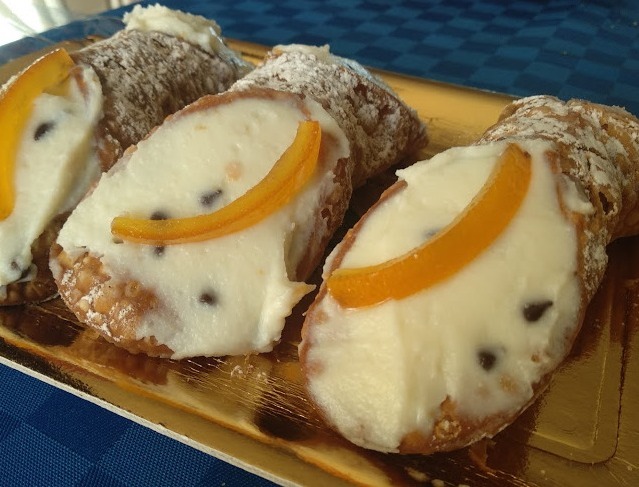
After indulging in savory delights, it’s time for sweets, and here the king is undoubtedly the Cannolo. This delight features a fried, crispy shell (“scorza”) filled with a soft, sweet sheep’s milk ricotta cream, enriched with chocolate chips and candied fruit. Cannoli were once considered a “harem dessert” by Emirs and Saracens and were later prepared in convents during the 19th century. It’s crucial to eat them freshly filled to maintain the shell’s crispness and the ricotta’s perfect texture.
Granita and Grattatella: Refreshing delights

When Palermo’s heat becomes intense, Granita offers refreshing relief. It’s a semi-frozen liquid mixture of water, sugar, and fruit juice or other ingredients like almond, pistachio, coffee, or cocoa. It’s lighter and more refreshing than traditional ice cream. It is often accompanied by a “brioscia,” a typical baked sweet bun, slightly flattened with a small “tuppu” (topknot) on top. Granita with brioscia is a typical Sicilian breakfast, especially in summer and coastal areas. Grattatella is similar to granita but made by shaving ice from a block and flavoring it with syrups, resulting in a slightly coarser, more granular texture.
Brioche con Gelato: A wild combination

Another sweet combination that will leave you speechless is the Brioche con Gelato (brioche with ice cream). Imagine a soft brioche bun, cut in half and generously filled with a large portion of ice cream. Classic flavors include hazelnut, chocolate, strawberry, pistachio, and coffee, but the variations are endless. Sometimes a waffle cone is added on top. It’s a true explosion of flavor and satisfaction, essentially a complete meal replacement, perhaps after a hearty lunch.
The Street Food experience: More than just food
Beyond the delicious flavors, Palermo’s street food offers a vibrant cultural experience. The markets are places of confluence and attraction, where people meet and socialize amidst the colors and aromas of exposed goods. Vendors engage with customers, often using unique calls (“abbanniate”) that range from simple price repetition to ironic and allusive expressions. This creates a spatial-relational dimension that extends through alleys and characterizes entire neighborhoods where merchants often live and work.
The resilience and vibrancy of Palermo’s street food tradition truly make it an unforgettable sensory journey.
Photos by depositphotos.com