
Welcome to a spiritual itinerary in Sicily, the “Anima Mundi” (Soul of the World) in the heart of the Mediterranean. I have envisioned this journey to guide you through a path dedicated to contemplation, prayer, and the discovery of treasures of faith that have profoundly marked the religious history of this land.
Sicily is a land where the sacred has always manifested itself in powerful, ancient, intense, and sometimes folkloristic forms. These have developed around very old sanctuaries, rural churches born from the simple faith of its inhabitants, and lesser-known places that emanate intense spiritual energy.
We cannot include every sacred site, but I will virtually accompany you on a one-week spiritual journey to discover some of the holy places that touch the soul, popular pilgrimage destinations, and treasures of popular devotion.
Remember that a sanctuary is a sacred place dedicated to veneration, a place of particular spiritual importance where the faithful seek comfort or miracles. Always maintain an attitude of respect and, where possible, silence in places of worship.
Day 1: Palermo – The City’s Devotion to Santa Rosalia, “the Santuzza”

We begin our pilgrimage in Palermo, a city whose religious history reflects a fusion of diverse cultures.
Sanctuary of Santa Rosalia (Monte Pellegrino)
Location: Situated on Monte Pellegrino, this sanctuary is the heart of Palermitan devotion. It is partly carved into the rock, offering a mystical atmosphere and a panoramic view.
History: The site has ancient origins, linked to pagan rituals, cults of the Madonna, and the presence of hermits. The current sanctuary took shape after the discovery of the bones believed to be those of Santa Rosalia on July 15, 1624, followed by a miracle that ended the plague. Legend has it that Santa Rosalia lived and died here as a hermit in 1170. Her relics were carried in solemn procession to eradicate the plague. Since 1954, the sacred site has been entrusted to the religiosos of Opera Don Orione.
Spiritual Significance: It is a destination of intense prayer and pilgrimage, where the faithful ask for graces and leave votive offerings. The ascent up the mountain is experienced as a moment of penance and reflection, culminating in the “acchianata” (climb) on foot, sometimes even on knees, especially for the feast on September 4th. The cave offers a spiritual climate, with bare rock walls and water that drips and is collected by the faithful.
Tips: Reachable by bus (line 812 from Piazza Politeama) or taxi. You can also follow the ancient path on foot. Dedicate time to prayer in the sacred cave.
Palermo Cathedral

Location: An imposing building in the historic centre of Palermo.
History: Its origins trace back to the early Christian era. It was transformed into a mosque and then reconverted to Christian worship by the Normans. Its different architectural phases testify to centuries of religious history.
Spiritual Significance: Dedicated to the Virgin Mary Assumed into Heaven, it is a symbol of the island’s complex religious history. It houses the relics of Santa Rosalia and royal tombs.
Tips: Admire the different architectural phases, the tombs of the Norman kings, the crypt with its treasures, and the roofs. Consider attending a religious service.
Day 2: Monreale – The Bible carved in gold
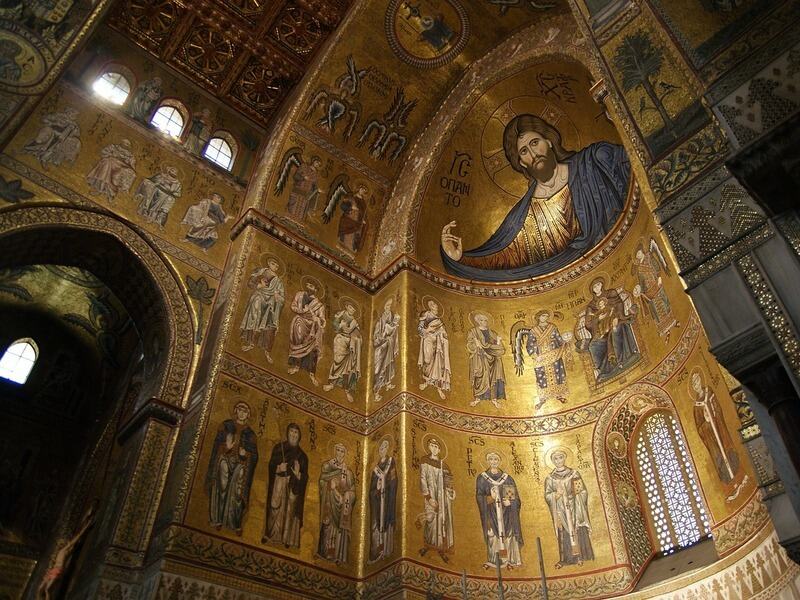
On the second day, we move to Monreale, nestled in the hills overlooking Palermo, to visit a masterpiece of art and faith.
Monreale Cathedral (Cattedrale di Santa Maria Nuova)
Location: The main church of Monreale, a beautiful town very close to Palermo.
History: Commissioned by the Norman King William II in the 12th century. It is considered one of the greatest masterpieces of Norman, Arab-Norman-Byzantine art in the world.
Spiritual Significance: It offers an unforgettable spiritual and artistic experience. The over 6,000 square metres of golden Byzantine mosaics narrate biblical stories, creating an environment of sublime beauty and profound visual catechesis. The Christ Pantocrator in the apse dominates and blesses. The adjacent Cloister, with its historiated columns, invites meditation.
Tips: Reachable from Palermo by bus or taxi. Dedicate at least half a day to the visit. Observe the mosaics in silence. You can participate in Holy Mass to immerse yourself in the spiritual atmosphere of the place. Don’t forget to admire the wonderful Benedictine Cloister, with its finely decorated columns and historiated capitals.
Day 3: Cefalù – The Norman masterpiece and the Christ Pantocrator

About sixty kilometres from Palermo, the splendid seaside town of Cefalù welcomes us, a very sought-after tourist destination. We will focus on its spiritual aspect.
Duomo di Cefalù (Basilica Cattedrale della Trasfigurazione)
A jewel of Arab-Norman art and one of the most extraordinary products of medieval Sicilian architecture. Its importance lies in its ability to harmoniously blend Norman Cistercian architecture with Byzantine and Arab elements.
Location: The cathedral stands above the town, towering over the houses facing the sea.
History: Construction began on June 7, 1131, at the behest of King Ruggero II d’Altavilla. Ruggero II promoted it out of devotion and gratitude towards the Most Holy Saviour and also conceived it as a mausoleum for himself and his descendants. Since July 3, 2015, it has been part of the UNESCO World Heritage site.
Tips: The majestic facade features a portico and two different towers with distinct battlements symbolising the spiritual power of the church and the temporal power of the crown. Inside, the basilical plan with three naves and columns leads to the most fascinating element: the splendid mosaic decorations in the apse. Created by Greek monks, these mosaics are considered among the most beautiful in Sicily. The majestic figure of the “Christ Pantocrator” dominates the apse dome, blessing and holding the Gospel. Below Him are depicted the Madonna, the Archangels, the Evangelists, the Apostles, the Prophets, and the Church Fathers. The figure of the Pantocrator produces a powerful moral effect, representing divine omnipotence. Admire these mosaics in silence, allowing yourselves to be uplifted by their beauty and theological meaning.
Day 4: Tindari – The Black Madonna watching from above

The fourth stop takes us to Tindari, an important centre of Marian devotion in Sicily.
Sanctuary of the Black Madonna of Tindari
Location: in the hamlet of Patti in the province of Messina. Perched on a promontory with spectacular views of the Tyrrhenian Sea and the Marinello lakes.
History: The site was an ancient Greek acropolis and a Byzantine episcopal see. The origin of the statue of the Black Madonna is uncertain. The best-known legend narrates that the statue miraculously arrived by sea in the 8th-9th century to escape iconoclastic persecution. The ancient sanctuary was destroyed and rebuilt around the mid-1500s. The new, larger church was built in the last century.
The wooden statue of the Brown Madonna is venerated for its numerous miracles and has attracted pilgrims for centuries. The inscription “Nigra sum sed formosa” (“I am black but beautiful”) has deep symbolic value. The chromatic composition of the statue is rich in symbolic meanings (red for royalty/divinity, blue for human nature). The legend of the Marinello Lakes, formed to save a child who fell from the promontory following a miracle by the Madonna, adds a touch of magic and faith to the place.
Tips: Take a moment for personal prayer or the recitation of the Rosary before the icon. The surrounding environment helps to inspire reflection, instilling a sense of peace and serenity.
Day 5: Catania – The indomitable strength of Sant’Agata

The fifth day takes us to Catania, a city deeply tied to the figure of its patron saint, Sant’Agata.
Catania Cathedral (Duomo di Catania)
It houses the precious relics of Sant’Agata. Its history, with continuous rebirths, is a symbol of the tenacious faith of the Catanese people and the protection invoked against natural calamities. The Chapel of Sant’Agata is a place of intense veneration.
Location: The heart of Catania’s historic centre.
History: Dedicated to the young martyr Agata. It has been rebuilt several times due to earthquakes and eruptions of Mount Etna.
Tips: Visit the Cathedral and the Chapel of Sant’Agata with devotion. If your trip coincides with the feast of Sant’Agata (February 3-5 or August 17), be prepared for an overwhelming experience of popular faith, but also for large crowds.
Day 6: Siracusa – The miraculous tears and Marian comfort

We continue our pilgrimage to Siracusa for a significant stop linked to a recent mystical event.
Sanctuary of the Madonna delle Lacrime
An imposing and modern sanctuary erected after the prodigious weeping of an image of the Madonna. It is a place of great attraction for pilgrims.
Location: A modern construction in the new part of Siracusa.
History: Erected following the miraculous weeping of a plaster effigy depicting the Immaculate Heart of Mary, which occurred in a humble dwelling in 1953. The tears were analysed and found to be of similar composition to human tear fluid. Construction, which began in 1966, was only completed in 1994 due to controversy.
It is an important place of prayer and Marian devotion, where pilgrims from all over the world seek comfort, hope, and intercession. Its imposing architecture, with a conical structure 103 metres high, has been interpreted in various ways, including the elevation of humanity towards God, Mary guiding towards Jesus, or a tear descending. The sanctuary is composed of the Basilica (upper temple) and the Crypt (lower temple). The prodigious image is kept in the main altar of the upper temple but is preserved in the Crypt (lower temple) along with the Reliquary of the Tears.
Tips: Dedicate the morning to the visit. It is a place of profound spirituality and reflection. Visit the Crypt, where the miraculous effigy and the Reliquary of the Tears are preserved. Participate in Holy Mass or dedicate time to personal prayer. The architecture itself invites spiritual elevation.
Day 7: Trapani – The art and devotion to the Madonna dell’Annunziata
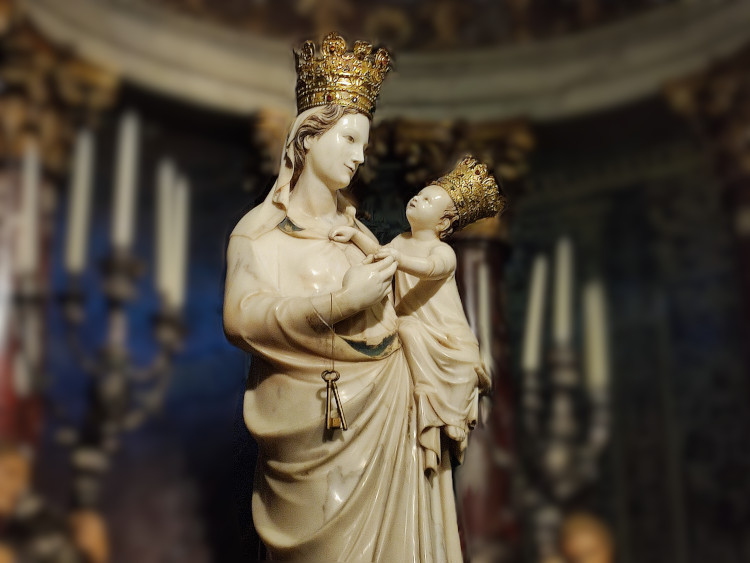
We conclude our itinerary with a “jump” to Trapani to surrender to the sweetness of the Madonna of Trapani.
Sanctuary of the Madonna of Trapani (Carmelite Monastery of the Annunziata)
This sanctuary houses a masterpiece of art and spirituality: the marble statue of the Madonna of Trapani. The statue, about 1.65m high, is an image of the “Madonna of Tenderness”, also known as the “Madonna of Grace” or “the Annunziata”. She is venerated as co-patroness of the city of Trapani.
History and the Statue: Although the exact circumstances of its arrival are surrounded by legends speaking of shipwrecks and miracles, more realistic hypotheses suggest the statue was commissioned around 1342 by Pisan merchants and delivered to the newly built Sanctuary of the Annunziata. The Virgin is represented standing with the Child Jesus on her left arm, caressing his left hand with her right. The Madonna’s face is described as sweet and amiable, with a thoughtful gaze that contrasts with the Child’s joyful impulse. The work evokes serenity, and devotees often go behind it to touch the stone.The statue of Our Lady of Trapani and its shrineHistory and the Statue: Although the exact circumstances of its arrival are surrounded by legends speaking of shipwrecks and miracles, more realistic hypotheses suggest the statue was commissioned around 1342 by Pisan merchants and delivered to the newly built Sanctuary of the Annunziata. The Virgin is represented standing with the Child Jesus on her left arm, caressing his left hand with her right. The Madonna’s face is described as sweet and amiable, with a thoughtful gaze that contrasts with the Child’s joyful impulse. The work evokes serenity, and devotees often go behind it to touch the stone.
The Chapel and the Sanctuary: The statue is housed in the Sacello within the Chapel of the Madonna of Trapani. The chapel was built around 1370 and later restored and enriched with Renaissance marble artefacts. The sanctuary itself, which is very different today from the first church of the 13th century, features a Gothic facade and a Baroque bell tower.
Tips: The Sanctuary of the Annunziata is located in Trapani, Via Conte Agostino Pepoli, 178. It is open daily. Dedicate a moment of personal prayer before the statue of the Madonna of Trapani. Admire the artistic richness of the chapel and the sanctuary. Popular devotion is very strong, especially during the liturgical feast on August 16th and the preceding 15 days (“la Quindicina della Madonna”) with pilgrimages, sometimes barefoot or on knees.
General tips for a Spiritual Pilgrimage
- Spiritual Preparation: Before departing, dedicate time to prayer and reflection on your intentions.
- Attire: Remember appropriate clothing (shoulders and knees covered) for entering places of worship.
- Silence and Respect: Maintain a respectful attitude and silence, especially in places of prayer.
- Sacraments: If you wish, inquire about the times for Holy Mass and Confession.
- Open Heart: Be open to encounters and moments of grace.
In conclusion, that’s all for now. May this pilgrimage in Sicily be a source of spiritual renewal and inner peace for each of you.
Have a good journey of faith!
